

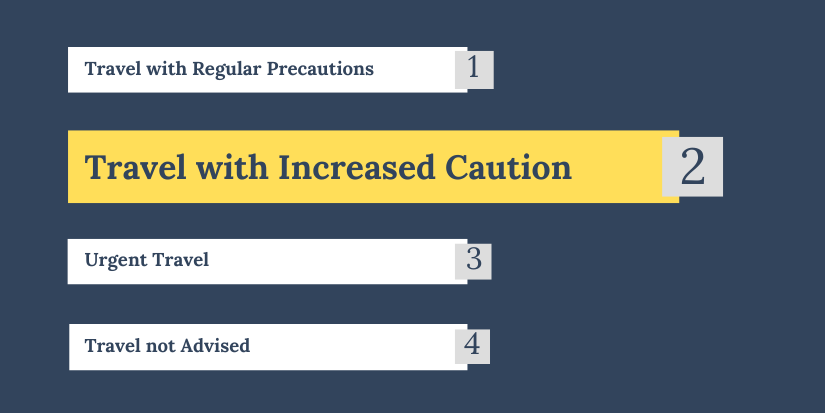
VISA REGIME
For holders of national passports and other travel documents: Visa required
For holders of diplomatic and official passports: No visas required for visits of up to 90 days
Note: Visa is required for the holder of an emergency travel document in transit
ENTERING AND LEAVING THE COUNTRY
The visitors can enter Angola either through the new Dr. António Agostinho Neto International Airport (NBJ) in Luanda or by land from one of the neighboring countries. Visa applications can be submitted at the Embassy of the Republic of Angola in Belgrade or through the website http://www.smevisa.gov.ao/. Starting from October 26, 2023, possession of a yellow fever vaccination certificate (yellow card) is not mandatory. For tourist travel, the passport must be valid for more than six months.
SOCIAL SECURITY AGREEMENT
No social security agreement has been concluded.
USEFUL INFORMATION
HEALTH SITUATION — Among tropical diseases, malaria is the most prevalent; therefore, the use of mosquito repellent (e.g., Autan Tropical or similar) is recommended. Wearing clothing that covers the body (long trousers, long-sleeved shirts) is recommended. Cholera is present as well, so the use of bottled water is always recommended. Food is considered safe only in hotels or higher-end restaurants.
Due to very expensive healthcare services, travel health insurance is strongly recommended.
SECURITY SITUATION — In July 2025, protests by citizens took place in Luanda and several other cities due to fuel price increases. During these protests, in addition to attacks on shops, banks, and other facilities, there were also attacks on private vehicles, buses, and vehicles used by ride-hailing applications (such as Yango and Heetch), during which a number of people lost their lives. The protests and unrest ended after several days, and since August 2025 the situation has stabilized again. The recommendations issued at that time to our citizens in Angola (to avoid unnecessary movement, stay away from gathering points, demonstrations, or areas with increased police presence, regularly follow instructions of the competent local authorities, monitor local media and security announcements, and maintain regular contact with the embassy) may be applied again should similar situations arise.
In Luanda and other cities, robberies and thefts occur relatively frequently (both during the day and at night) in central areas with shopping centers, restaurants, and hotels, as well as in peripheral parts of the city (primarily inhabited by the local population and which should not be visited without necessity). Attacks on vehicles during traffic congestion also occur, usually carried out by armed perpetrators on motorcycles. Foreigners are often targeted, and perpetrators do not aim only for cash but also for credit cards and mobile phones.
TRANSPORT — Public city traffic is almost non-existent. There are mostly vans, used exclusively by the local population Taxi services are developed and relatively safe, and vehicles can be ordered via mobile applications (Yango, Heetch, etc.). During a tourist stay in Angola, one may only drive a motor vehicle with an international driving permit.
OTHER INFORMATION — The official currency of Angola is the Kwanza (AOA). Euro and US dollar are the two most frequently exchanged foreign currencies. It is safest to exchange foreign currency at a hotel or authorised exchange offices. Foreign payment cards are accepted in hotels, better restaurants, hypermarkets, and exclusive shops and boutiques.
Contact information:
During your stay in the Republic of Angola, for consular assistance and protection, you may contact the Embassy of the Republic of Serbia in Luanda+244 222 321 421, +244 222 327 240, +244 222 320 393, mobile phone number: +244 946 278 779, as well as e-mail address: srb.emb.angola@mfa.rs.